

Publications & External Validation
PUBLICATIONS
-
Use of non-intrusive laser exfoliation to improve substance uptake into citrus leaves. . https://doi.org/10.12688/f1000research.129789.1
-
Selective Wax Cuticle Removal Using Green Wavelength Lasers: A Non-Invasive Method for Enhancing Foliar Uptake. https://doi.org/10.3390/agriengineering7040119
-
Laser-induced cuticle removal improves foliar zinc uptake in row crops. https://doi.org/10.31220/agriRxiv.2025.00371
-
Foliar delivery via selective laser ablation of the leaf cuticle coupled with a reservoir patch. https://doi.org/10.31220/agriRxiv.2025.00376
-
Laser technology boosts agrochemical absorption: Partners wanted for field trials. AgriTech Tomorrow. https://www.agritechtomorrow.com/content.php?post=16597
-
Foliar delivery via selective laser ablation of the leaf cuticle coupled with a reservoir patch. https://www.agritechtomorrow.com/content.php?post=16597
-
Laser-induced cuticle removal improves foliar zinc uptake in row. crops.https://www.cabidigitallibrary.org/doi/10.31220/agriRxiv.2025.00371
-
Foliar Delivery in Strawberry via Selective Laser Cuticle Ablation Coupled with a Reservoir Patch. https://www.cabidigitallibrary.org/doi/10.31220/agriRxiv.2025.00381

External Collaborators
⭐️⭐️⭐️⭐️⭐️
Academic Research
University of Memphis
Research collaboration focused on sunflower and related crops, supporting experimental design, plant physiology studies, and data analysis for foliar laser-enabled uptake.
Texas A&M University
Research collaboration focused on citrus, specifically evaluating FLB-enabled improvement of peptide penetration and associated biological response under controlled experimental conditions.
⭐️⭐️⭐️⭐️⭐️
Technology & Hardware Collaboration
Opt Lasers
Hardware supplier collaboration under agreement, supporting development and integration of high-power laser modules for FLB system implementations.
Diverse Vitality
Diverse Vitality
Collaboration focused on improving foliar uptake of Diverse Vitality peptides using the FLB platform, including evaluation of delivery performance under applied conditions.
⭐️⭐️⭐️⭐️⭐️
Independent Trials
Ag Metrics Group
Independent trials evaluating FLB-enabled foliar delivery, including micronutrient uptake studies.
Southeast Ag Research
Strawberry greenhouse trials supporting applied validation of FLB-enabled foliar delivery.
Agricenter International
Cotton field testing supporting validation of FLB applications
Grove First
Citrus HLB trials using the FLB platform to evaluate delivery of diverse treatment compounds
Trials and Proof of Concepts
Laser-Enhanced Peptide Delivery for HLB Control
FLB improves foliar delivery of citrus-derived antimicrobial peptides by enabling efficient penetration through the leaf wax cuticle, supporting a practical, non-invasive field application method.
Key outcome:
In a proof-of-concept field evaluation, FLB (laser + peptide spray) achieved >98% bacterial clearance after two treatments (Days 0 & 30), showing the strongest and most sustained reduction among the tested delivery methods.
Third-party validation:
HLB bacterial levels quantified by qPCR performed by Texas A&M University, with a 70-day follow-up (10 trees per group).

HLB bacterial clearance by delivery method (qPCR over 70 days).
Citrus — Oxytetracycline (OTC) Uptake Enhanced by FLB (Proof of Concept)
FLB dramatically increases oxytetracycline (OTC) uptake in citrus leaves, overcoming the foliar penetration limits of conventional spray application.
Key outcome:
In a proof-of-concept evaluation, FLB (laser + micro-sprayer) demonstrated ~20× higher OTC levels in leaf tissue compared to micro-sprayer alone.
Third-party validation:
OTC concentrations quantified by LC-MS/MS analysis performed by Trilogy Analytical Laboratories.
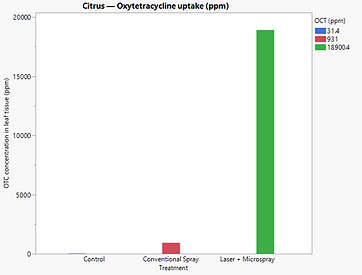
Citrus OTC concentration (ppb) (Leaf tissue OTC concentration measured 48 h after application)
-
Untreated control: ~31 ppb
-
Conventional micro-sprayer: ~931 ppb
-
FLB (laser + micro-sprayer): ~18,900 ppb
Grapevine — Zn Uptake Enhanced by FLB + Patch
FLB combined with a localized reservoir patch dramatically increases zinc uptake in grapevine leaves, outperforming conventional foliar spray and laser + spray.
Key outcome:
FLB + Patch increased Zn uptake to ~2.0× vs spray alone (Control = 100; FLB + Patch = ~199).
Third-party validation:
Zn uptake quantified by ICP-OES analysis performed by Waypoint Analytical.

Grapevine Zn uptake (normalized)
(Zn uptake; Control = 100)
-
Control (spray only): 100
-
FLB (laser + spray): ~110
-
FLB + Patch: ~199
Validated using FLB-02 (manual platform).
Laser + Patch Delivery for Foliar Zinc Uptake in Blueberry
(Proof of Concept)
FLB combined with a biodegradable reservoir patch enables sustained, localized foliar delivery by overcoming the wax cuticle barrier and maintaining prolonged contact of the applied compound.
Key outcome:
In a proof-of-concept study on blueberry, FLB + Patch produced a several-fold increase in zinc uptake compared to conventional foliar application, demonstrating strong enhancement of delivery efficiency under identical dosing conditions.
Third-party validation:
Zinc uptake quantified by ICP-OES analysis performed by Waypoint Analytical on pooled leaf samples collected from 10 plants per treatment.

Blueberry zinc uptake by delivery method
(ICP-OES analysis; values normalized to control)
-
Untreated control: baseline Zn levels
-
Laser only (no patch): moderate increase
-
FLB + Patch: several-fold increase in Zn uptake
Proof-of-concept trial conducted on Vaccinium corymbosum (blueberry) plants under controlled conditions.
Laser + Patch Delivery for Foliar Zinc Uptake in Privet (Proof of Concept)
FLB combined with a biodegradable reservoir patch enables sustained, localized foliar delivery by overcoming the wax cuticle barrier and maintaining prolonged contact of the applied compound, even in dense, woody canopies.
Key outcome:
In a proof-of-concept study on privet (Ligustrum spp.), FLB + Patch produced a clear increase in zinc uptake compared to control and laser-only treatments, demonstrating enhanced delivery efficiency under a single optical recipe.
Third-party validation:
Zinc uptake quantified by ICP-OES analysis performed by Waypoint Analytical on pooled leaf samples collected from 10 plants per treatment.

Privet zinc uptake by delivery method
(ICP-OES analysis; values normalized to control)
-
Untreated control: baseline Zn levels
-
Laser only (no patch): modest increase
-
FLB + Patch: near-doubling of Zn uptake relative to control
Proof-of-concept trial conducted on Ligustrum spp. (privet), a woody shrub with dense, highly ramified foliage.
Strawberry — Zn Uptake Enhanced by FLB (Laser + Foliar Spray)
FLB improves zinc uptake using standard foliar spray practices, increasing absorption without changing the formulation.
Key outcome:
FLB (laser + spray) increased Zn uptake to ~1.47× vs spray alone (Control = 100; FLB = ~147).
Third-party validation:
Zn uptake quantified by ICP-OES analysis performed by Waypoint Analytical.

Strawberry Zn uptake (normalized)
-
(Zn uptake; Control) = 100)
-
Control (spray only): 100
-
FLB (laser + spray): ~147
Validated using FLB-02 (manual platform). Field-ready FLB-100 enables scalable field deployment.
Laser-Enhanced Foliar Zinc Uptake in Tomato Plants (Proof of Concept)
FLB enables improved foliar zinc absorption by selectively removing the leaf wax cuticle, facilitating direct nutrient entry without damaging plant tissues.
Key outcome:
In a proof-of-concept study on tomato plants, laser-treated leaves showed a ~109% increase in zinc uptake, compared to only ~15.6% in untreated controls, demonstrating a strong enhancement of foliar absorption efficiency.
Third-party validation:
Zinc levels quantified by LIBS (Laser-Induced Breakdown Spectroscopy) following foliar application, using comparative spectral intensity analysis between treated and control plants (4 plants total).

Tomato zinc uptake following laser-assisted foliar application
(LIBS analysis; relative zinc concentration)
-
Untreated control: limited zinc uptake (~15.6%)
-
Laser-treated leaves: strong increase in zinc absorption (~109%)
Proof-of-concept study conducted on young tomato plants under controlled conditions using zinc sulfate foliar application.